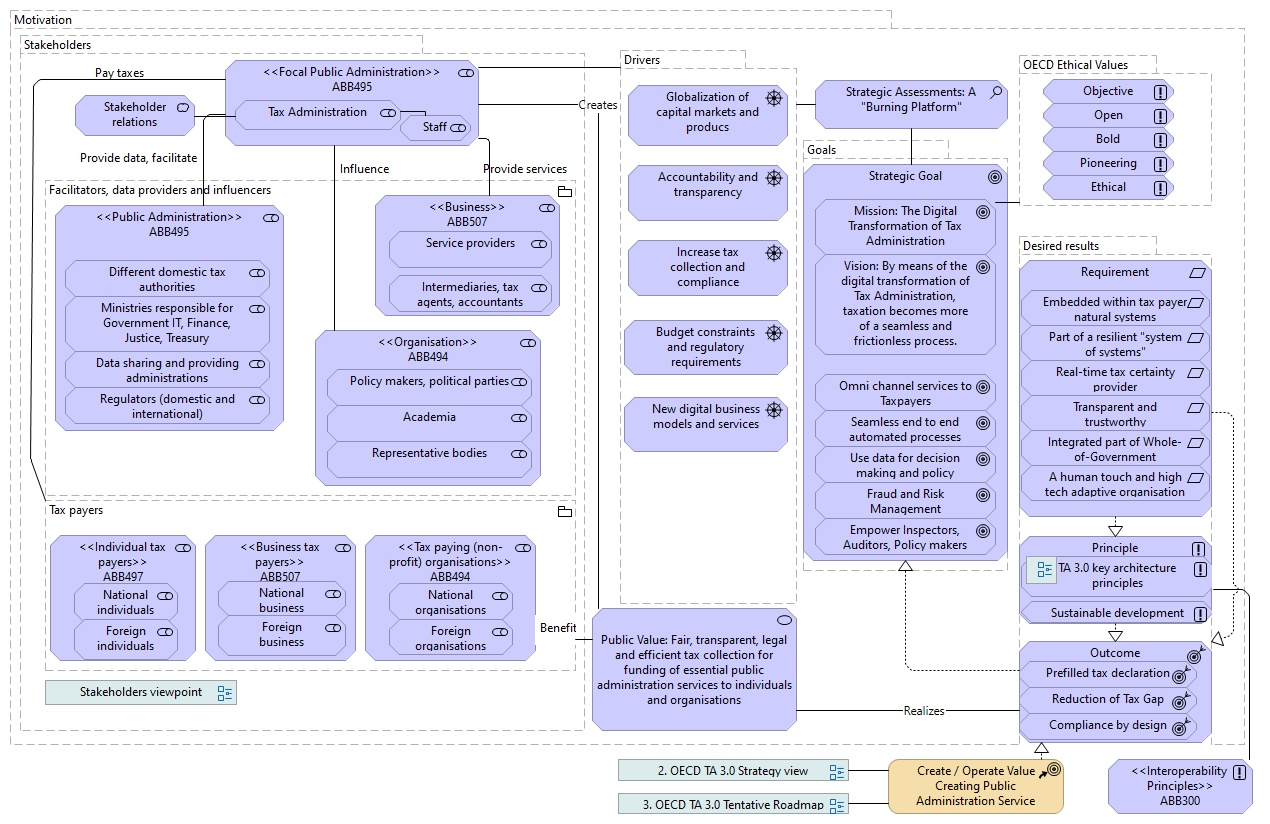
This view provides a high level overview of the OECD Tax Administration 3.0 (TA 3.0) public administration architecture.
This architecture summarizes the most salient elements that could contribute to achieving a TA 3.0 capability for a tax administration.
Narrative.
The top part of this view shows the elements that belong to the [Motivation] group.
1. Stakeholders.
1.1. Focal Public Administration.
The central unit of analysis in this tax architecture is a [Tax administration] that is willing to develop and / or deploy a TA 3.0 capability. It is shown at the top left of the view.
The major [Stategic Goal] of the [Tax administration] is summarized in the mission statement [Mission: The Digital Transformation of Tax Administration].
This is the central goal that is pursued by this architecture.
The [Staff] of the [Tax administration] is identified as a group of key stakeholders for digital transformation.
1.2. Tax payers.
A vitally important group of [Stakeholders] are the [Tax payers]. This stakeholder group is relevant for the demand side of digital public tax services as well as a source of feedback. Different roles are identified for [Individual tax payers], [Business tax payers] and [Tax paying organisations]. This is because these groups may have different treatment by a tax administration. For each role in the [Tax payers] group, the difference is also made between national and foreign entities, again, because their treatment by the [Tax administration] is potentially different. The [Tax payers] are also the major beneficiaries of the [Public Value] that is created by the [Tax administration].
1.3. Facilitators, data providers and influencers.
Another important class of stakeholders for the [Tax administration] are the group of [Facilitators, data providers and influencers]:
1.3.1. Public administrations that provide data and facilitate the work of the [Tax administration].
Among these are other [Public administrations], for example the other levels of tax authorities (National, regional and local), and different [Ministries]:
Also the [Data sharing and providing administrations] have an important role. These are a variety of national authorities, government offices and organisations.
Besides of providing and sharing data, their role may also be to offer joint Whole of Government (WoG) services.
1.3.2. Businesses that provide services to the [Tax administration].
The first class of stakeholders in this category are the [Service providers], such as software providers ad developers, hardware providers, network providers, quality assurance, project support, encryption key managers, IT-security auditors, data asset agencies.
A second very important group of stakeholders are the [Intermediaries, tax agents, accountants]. these are key stakeholders in tax iniatives and tax policy areas.
1.3.3. [Organisations] that influence the [Tax administration].
The [Policy makers, political parties] are among the most influential stakeholders of the [Tax administration].
[Academia], ie. Universities and research institutions, influence the [Tax administration ] because digital transformation requires constant support from the scientific domain, but the accumulated knowledge can also aid the government in adopting emerging technologies.
[Representative bodies] influencing the [Tax authority] are:
• Advisory boards
• Third sector, industry associations, trade unions
• International operators
• Media
The details on the stakeholders and their respective roles are available in the [Stakeholders viewpoint].
2. Drivers.
The Tax administration has a number of reasons to pursue the development of the Tax 3.0 capability. These are represented in the model in the group of the [Drivers]. A Driver represents an external or internal condition that motivates an organization to define its goals and implement the changes necessary to achieve them. The drivers that motivate the goal of developing the Tax 3.0 capability are:
2.1 The [Globalization of capital markets and producs]
2.2 The need / stakeholder expectation of [Accountability and transparency]
2.3. The urge to [Increase tax collenction and compliance],
2.4. The pressure of [Budget constraints and regulatory requirements] and
2.5. The emergence of [New digital business models and services].
These [Drivers] motivate the [Tax administration] to define a number of [Strategic goals].
3. [Strategic Assessments]
The process of weighing the different elements that are in play to evolve from stakeholder needs and drivers to strategic goals is through the making of a number of strategic assessments.
These are summarised in the chapter on "A burning platform" (OECD 2020) and contain a number of limitations that are identified in the current system to narrow tax gaps substantially and to reduce the compliance burden. Besides of that, there are concerns on the access and use of information, the changing societal expectations and privacy, security and transparency.
4. Vision, Mission and Strategic Goals.
The [Drivers] and [Strategic Assessments] give rise to the formulation of the [Mission], the [Vision] and the [Strategic Goals] in this Tax 3.0 architecture.
The Mission and the Vision are laid out in document: OECD (2020), Tax Administration 3.0: The Digital Transformation of Tax Administration, OECD, Paris.
4.1 [Mission: The Digital Transformation of Tax Administration] c
4.2 [Vision: By means of the digital transformation of tax administration, taxation becomes more of a seamless and frictionless process.]
The OECD etical values are put forward as general principles to be followed in this architecture.
4.3 The following strategic goals are derived from the vision and the mission:
4.3.1 Provide [Omni channel services to Taxpayers],
4.3.2 [Seamless end to end automated processes],
4.3.3 [Use data for decision making and policy],
4.3.4 Improve [Fraud and Risk Management] and
4.3.5 [Empower Inspectors, Auditors and Policy makers].