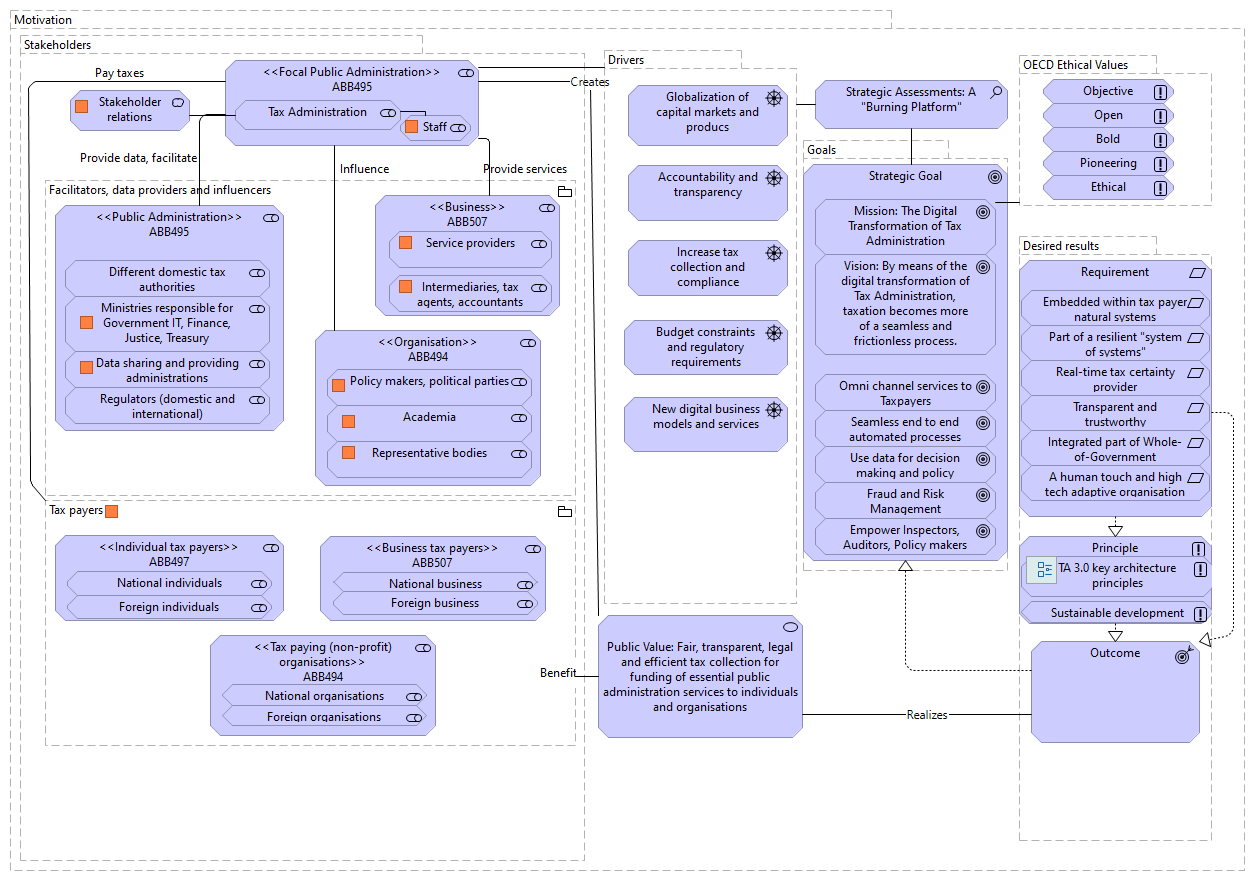
This viewpoint provides the stakeholders overview of the OECD Tax Administration 3.0 (TA 3.0) public administration architecture.
In this viewpoint, only the narrative concerning stakeholders is provided in a more detailed way.
Narrative.
1. Stakeholders.
1.1. Focal Public Administration.
The central unit of analysis in this tax architecture is a [Tax administration] that is willing to develop and / or deploy a TA 3.0 capability. It is shown at the top left of the view. The [Staff] of the [Tax administration] is identified as a group of key stakeholders for digital transformation, be it technology areas (what can be done), core business areas (what should be done), legal areas (what is allowed to be done) or budget areas (what we can afford to be done). Having them on the same page in terms of the direction, depth, pace or tools of digital transformation is extremely difficult and requires a lot of effort.
1.2. Tax payers.
A vitally important group of [Stakeholders] are the [Tax payers]. This stakeholder group is relevant for the demand side of digital public tax services as well as a source of feedback. Different roles are identified for [Individual tax payers], [Business tax payers] and [Tax paying organisations]. This is because these groups may have different treatment by a tax administration. For each role in the [Tax payers] group, the difference is also made between national and foreign entities, again, because their treatment by the [Tax administration] is potentially different.
1.3. Facilitators, data providers and influencers.
Another important class of stakeholders for the [Tax administration] are the group of [Facilitators, data providers and influencers].
1.3.1. Public administrations that provide data and facilitate the work of the [Tax administration].
Among these are other [Public administrations], for example the other levels of tax authorities (National, regional and local), and different [Ministries]:
- ministry responsible for government IT,
- ministry of finance,
- ministry of justice,
- department of treasury
The roles these [Ministries] have to play is:
- Cooperation in legislation
- Securing the funding and resources.
- Mandate to plan, design, regulate and facilitate digital transformation.
- Supervising organisation
Besides of these [Ministries], also the [Data sharing and providing administrations] have an important role. These are a variety of national authorities, government offices and organisations such as:
- Customs, treasury, statistics, companies’ registration office, home affairs, social services and benefits.
- CIOs, CDOs, CISOs around the government
- Digitalization agencies and groups
Besides of providing and sharing data, their role may also be to offer joint Whole of Government (WoG) services.
1.3.2. Businesses that provide services to the [Tax administration].
The first class of stakeholders in this category are the [Service providers], such as software providers ad developers, hardware providers, network providers, quality assurance, project support, encryption key managers, IT-security auditors, data asset agencies
Role:
- Key stakeholders in digital services as developers to our services and as providers to the clients. Customers want services to be available through APIs, using the user interface of their choice instead of those provided by the tax agency.
- TA's services are dependent on the quality of software providers' implementation.
- Software providers can be good sources of information regarding the actual demands and practices of the clientele, which is useful when designing services.
- Collaboration: co-creation of end-services in customer environment.
A second very important group of stakeholders are the [Intermediaries, tax agents, accountants]. these are key stakeholders in tax iniatives and tax policy areas.
1.3.3. [Organisations] that influence the [Tax administration].
The [Policy makers, political parties] are among the most influential stakeholders of the [Tax administration].
Their Role:
- Important source for requirements
- They set the framework (technology, data access, business requirements, etc.)
- The [Tax administration] wants to influence political decision making and other societal issues.
- There is a requirement of certain level of loyality towards the sitting government and its programme, which affects the way general discussion influencing how work is conducted.
- Provide policy, legislation, budget.
[Academia], ie. Universities and research institutions, influence the [Tax administration ] because digital transformation requires constant support from the scientific domain, but the accumulated knowledge can also aid the government in adopting emerging technologies.
[Representative bodies] influence the [Tax authority] as follows:
• Advisory boards
Stakeholders:
- Council for Telecommunications and Information Technology:
Role:
- a strategic advisory board tasked with both oversight of government IT and and professional approval of IT-related public procurement
• Third sector, industry associations, trade unions
• International operators
Stakeholders:
- Nordic Smart Government,
- EU
- OECD in terms of our alignment (International TA 3.0 to aspirational level)
• Media
2. Stakeholder relations.
The [Stakeholder relations] "meaning" box contains a description of stakeholder relations work elements:
- Internal regulations for stakeholder collaboration.
- Coordination and a lot of stakeholder cooperation
- Internal website for collaborations, rules, who are responsible and guiding principles.
- Collecting customer insight for development work. Common education with different stakeholders.
- Planning and executing guidance together with stakeholders or discussing about specific challenges.
- Building infrastructure and services together for common customer.
- Working in an ecosystem together.
- Influencing legislation together.
- Understanding and recognising stakeholders who might be against TA's goals or who TA needs to work with. Modulating stakeholders goals closer to TA's goals is one aim. Raising issues to public discussion.